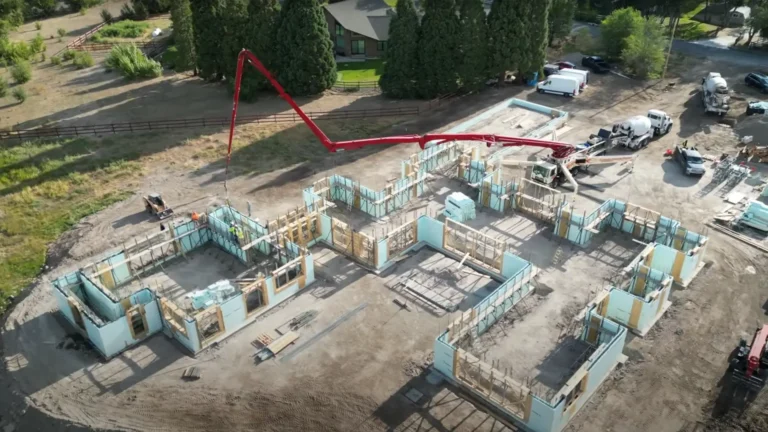
A comprehensive comparison to help you make the best decision for your new California home.
Fire Safety Comparison
This is perhaps the most critical difference for California homeowners. ICF walls achieve a 4-hour fire rating—meaning they maintain structural integrity for 4 hours of direct fire exposure. Traditional wood framing achieves only a 45-minute rating. In wildfire-prone areas of the Sacramento foothills, this difference can be the margin between saving and losing your home.
Energy Performance
ICF’s continuous insulation eliminates thermal bridging that occurs at every stud in a wood-frame wall. Real-world testing shows ICF homes use 25-50% less energy for heating and cooling. In Sacramento’s climate, with summer temperatures regularly exceeding 100°F, this translates to thousands of dollars in annual savings. The concrete’s thermal mass also helps maintain consistent indoor temperatures.
Structural Strength
ICF walls are solid reinforced concrete—the same material used for bridges, highways, and high-rise buildings. They meet IBC seismic codes as Special Reinforced Concrete Shear Walls and are ASTM E2126 certified. Wood-frame construction relies on nail connections and sheathing for lateral strength, which can fail under extreme seismic or wind loads.
Durability & Maintenance
ICF homes have a projected lifespan of 75-100 years with minimal maintenance. Concrete doesn’t rot, warp, or attract termites. Wood-frame homes typically last 30-50 years and require ongoing maintenance including pest treatment, paint, and eventual structural repairs. Over a lifetime, ICF’s lower maintenance costs offset the higher initial investment.
Cost Analysis
ICF construction typically costs 5-10% more than traditional wood framing upfront. However, when you factor in 25-50% energy savings over 30+ years, reduced insurance premiums, minimal maintenance, and a structure that lasts 2-3 times longer, ICF is actually the more economical choice. Many lenders and insurance companies now offer favorable terms for ICF construction.